
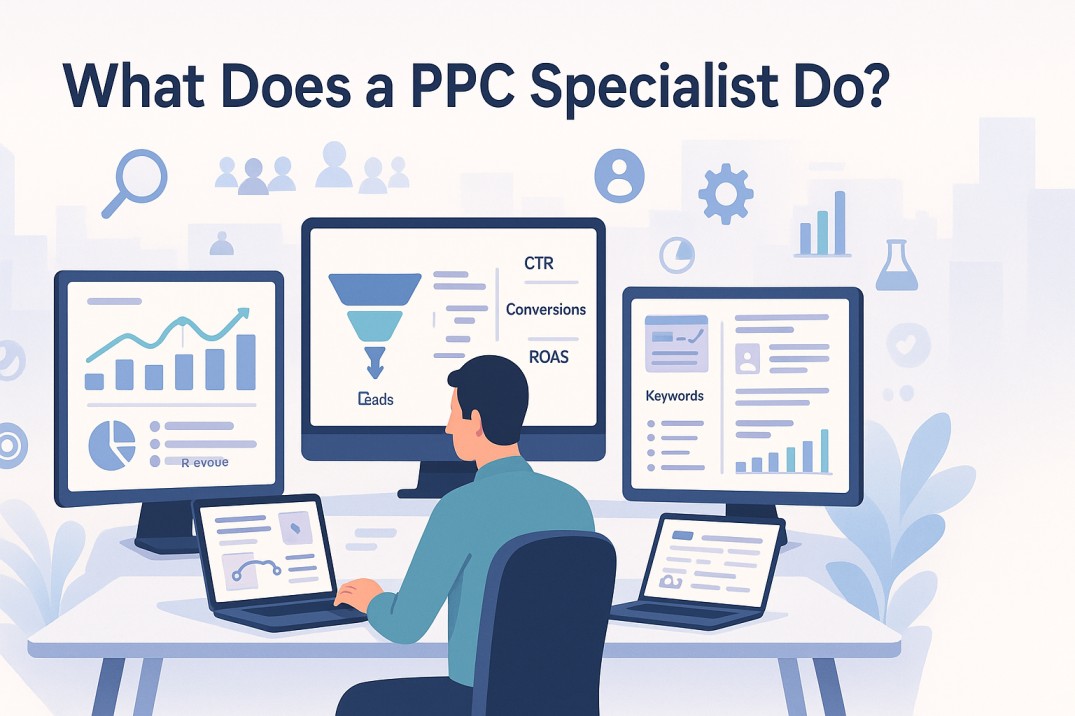
A PPC specialist plans, launches, manages, and improves paid ad campaigns so a business can generate more qualified traffic, leads, and sales without wasting budget. In practice, that means handling keyword research, audience targeting, ad copy, bidding, tracking, testing, reporting, and ongoing optimization across platforms like Google Ads, Microsoft Ads, Meta Ads, and LinkedIn Ads. For agencies, a strong PPC specialist helps turn ad spend into measurable client growth. Google’s guidance also makes clear that profitable paid media depends on accurate conversion tracking, relevant ads, useful landing pages, and optimization around real business goals, not vanity metrics.
Paid media has become more important, not less. The IAB reported that U.S. digital ad revenue reached $258.6 billion in 2024, up 14.9% year over year, which helps explain why specialist execution matters more as competition grows. At the same time, the Bureau of Labor Statistics projects employment for advertising, promotions, and marketing managers to grow 6% from 2024 to 2034, with about 36,400 openings each year on average. That combination of rising spend and rising demand is exactly why agencies need people who can manage paid campaigns with discipline and accountability.
For full-service, SEO, social, and creative agencies, the real question is not whether PPC matters. It is whether the person managing it can protect margin, improve results, and give clients confidence in the numbers.
What is a PPC specialist?
A PPC specialist is a paid media professional responsible for driving conversions from paid advertising platforms. Their job is to connect business goals to campaign execution.
That usually includes:
- Researching keywords, audiences, and competitors
- Building campaign structures
- Writing and testing ads
- Setting bids and budgets
- Installing and validating tracking
- Monitoring performance daily or weekly
- Improving conversion rates over time
- Reporting on outcomes that matter
A PPC specialist does not just “run ads.” A good one builds a system that connects audience intent, ad relevance, landing page experience, and conversion measurement. That matters because Google says ad quality is closely tied to expected click-through rate, ad relevance, and landing page experience.
What does a PPC specialist actually do every day?
Daily work depends on account size, ad spend, and campaign maturity, but most PPC specialists rotate through the same core responsibilities.
What are the main responsibilities of a PPC specialist?
| Responsibility | What the specialist does | Why it matters |
| Research | Studies search intent, competitors, offers, and audience behavior | Prevents weak targeting and wasted spend |
| Campaign setup | Builds campaigns, ad groups, assets, audiences, and budgets | Creates a clear structure for testing and scale |
| Ad writing | Writes headlines, descriptions, and calls to action | Improves relevance and click-through rate |
| Tracking | Sets up conversion actions, tags, GA4 events, and reporting views | Makes optimization possible |
| Bid management | Chooses manual or automated bidding based on goals | Helps control CPA and improve ROAS |
| Optimization | Adds negatives, pauses waste, tests creatives, improves targeting | Lifts efficiency over time |
| Reporting | Shares, spend, leads, sales, CPA, ROAS, and next steps | Builds trust and supports retention |
That list sounds simple, but each area includes dozens of decisions that affect results.
How does a PPC specialist start a campaign?
A strong PPC specialist starts before the ads go live.
1. They clarify the goal
The best campaigns start with one clear objective:
- Lead generation
- Ecommerce sales
- Booked calls
- Demo requests
- Store visits
- Branded demand capture
Without a clear goal, the account fills up with noise. A lead-gen campaign should not be measured the same way as an ecommerce campaign. Google Ads itself emphasizes setting up conversion measurement around the actions that are actually valuable to the business.
2. They research intent
This is where PPC specialists earn their keep. They look for:
- High-intent search terms
- Low-quality queries to exclude
- Competitor positioning
- Geographic patterns
- Device behavior
- Audience segments with stronger buying signals
The key is not traffic volume alone. The key is traffic quality.
For example, an agency running Google Ads for a local service brand may discover that “emergency plumber near me” converts far better than broader informational keywords. The specialist then builds tighter ad groups, stronger copy, and more accurate landing-page alignment around that intent.
3. They build the account structure
Good structure improves control and reporting. Weak structure hides problems.
A PPC specialist will usually decide:
- Which campaign types to use
- How to group keywords or audiences
- Which landing page fits each offer
- Which locations, devices, or demographics deserve separate treatment
- How the budget should be split across campaigns
This is one reason many agencies use a dedicated PPC audit before scaling spend. A clean account structure makes later optimization much easier.
How does a PPC specialist improve campaign performance?
Optimization is the part most people see, but it only works when tracking and structure are already solid.
What does optimization include?
A PPC specialist typically improves performance by:
- Pausing low-quality keywords or audiences
- Adding negative keywords
- Refining match types
- Adjusting budgets toward winning campaigns
- Testing new ad copy
- Improving landing-page alignment
- Reviewing search terms for waste
- Segmenting by device, location, and time
- Comparing lead quality, not just lead volume
Google’s documentation on responsive search ads explains that the system tests combinations of headlines and descriptions over time to find better-performing messages. Smart Bidding also uses auction-time signals such as device, location, language, and context. That means specialists are no longer just “manual bid managers.” They are decision-makers who feed the platform better inputs and judge whether automation is helping or hurting performance.
A simple example
Imagine an agency client is generating leads, but the cost per lead keeps rising.
A skilled PPC specialist may find that:
- Broad queries are leaking budget
- One device type converts poorly
- The landing page does not match the offer
- Ads are too generic
- Conversion tracking counts low-quality actions
They then tighten query control, improve the ad message, fix the offer match, and track the right actions. In many cases, that improves both lead quality and cost efficiency.
Why is conversion tracking one of the most important parts of the job?
Without tracking, PPC becomes guesswork.
Google defines conversion tracking as the tool that shows what happens after a customer interacts with an ad, such as a purchase, sign-up, phone call, or download. Google also states that conversion setup helps advertisers see which keywords, ads, and campaigns are driving valuable actions.
What does a PPC specialist track?
A PPC specialist may track:
- Form submissions
- Phone calls
- Purchases
- Demo requests
- Quote requests
- Add-to-cart events
- Qualified booked meetings
- Offline sales imports
- GA4 key events linked back to Google Ads
This matters even more now because campaign automation needs reliable data. If poor-quality conversions are being passed into the ad platform, the platform may optimize toward the wrong behavior.
Which metrics does a PPC specialist care about most?
Not every metric deserves equal attention.
Useful performance metrics
| Metric | What it shows | Why it matters |
| CTR | Whether the ad attracts clicks | Helps diagnose relevance |
| CPC | Cost for each click | Impacts efficiency |
| Conversion rate | Share of clicks that turn into actions | Reflects landing-page and offer fit |
| CPA | Cost to generate a lead or sale | Core profitability metric |
| ROAS | Revenue returned from ad spend | Essential for ecommerce and revenue-focused accounts |
| Impression share | Visibility compared with available demand | Helps spot missed demand |
| Search terms | Actual user queries | Critical for waste control and insight |
| Lead quality | Whether conversions turn into a real pipeline | Protects client trust |
A PPC specialist should report on business outcomes first, then platform metrics second. Google’s own ROI guidance makes the same point: clicks and impressions matter less than whether ads drive real business results.
What skills make someone a strong PPC specialist?
A strong PPC specialist combines technical skill, commercial judgment, and communication.
Core PPC specialist skills
Analytical skill
They need to read patterns in performance data and separate symptoms from causes.
Platform skill
They must understand Google Ads, Microsoft Ads, Meta Ads, and supporting tools like GA4, Tag Manager, and reporting platforms.
Copywriting skill
They need to write clear, relevant ads that match user intent.
Testing mindset
They should treat campaign management as an ongoing process of learning and improving.
Business judgment
They need to understand margin, lead quality, sales cycles, and client goals.
Communication skill
They must explain what changed, why it changed, and what should happen next.
This blend matters more than ever because platforms are automating more, not less. Automation reduces repetitive work, but it does not replace good strategic decisions.
How do PPC specialists work with automation and AI?
The role has changed over the past few years.
A modern PPC specialist does not spend all day manually adjusting every keyword bid. Instead, they shape the system by improving:
- Conversion inputs
- Audience quality
- Ad relevance
- Landing page usefulness
- Budget allocation
- Testing priorities
Google says Smart Bidding uses auction-time signals and responsive search ads test combinations to improve relevance and performance. That means the specialist’s job is increasingly to guide automation with better strategy, better inputs, and sharper analysis.
What a PPC specialist should never do?
Even experienced teams can underperform when the basics are weak.
A PPC specialist should avoid:
- Optimizing toward clicks instead of outcomes
- Running ads without verified tracking
- Sending traffic to weak or mismatched landing pages
- Expanding too fast before performance stabilizes
- Ignoring search-term waste
- Making decisions on too little data
- Reporting volume without quality
- Copying generic account structures into every client account
These mistakes are often why agencies eventually consider white-label PPC vs. hiring in-house or partnering with a more specialized team.
PPC specialist vs paid media manager: what is the difference?
The titles overlap, but the roles can differ.
| Role | Typical focus | Best fit |
| PPC specialist | Execution, optimization, tracking, testing | Search-led or platform-specific performance work |
| Paid media manager | Broader channel oversight, planning, and reporting | Multi-channel client management |
| Paid media strategist | Forecasting, offer strategy, budget allocation, cross-channel growth | Senior strategic direction |
| White-label PPC partner | Scalable backend execution for multiple client accounts | Agencies that need delivery capacity |
In smaller agencies, one person may cover all four functions. In larger agencies, the work is usually split.
Why do agencies rely on PPC specialists?
Agencies do not just need campaigns launched. They need campaigns managed well enough to protect retention and margin.
How does a PPC specialist help an agency grow?
A strong PPC specialist helps agencies:
- Add paid media without building a large in-house team
- Improve client retention through measurable performance
- Reduce wasted spend and account instability
- Launch new accounts faster
- Deliver cleaner reporting
- Support upsells into search, display, shopping, video, or remarketing
This is especially relevant for agencies that already offer SEO, web design, or social but do not want to build a full paid media department from scratch. That is why many firms explore white-label PPC or PPC outsourcing when internal bandwidth becomes a bottleneck.
What results should you expect from a PPC specialist?
The honest answer is: it depends on the market, the offer, the budget, the landing page, and the sales process.
A PPC specialist can improve the odds of success, but they cannot guarantee identical results across all industries.
That said, you should expect a capable specialist to deliver:
- Clear measurement from the start
- A structured launch plan
- Useful reporting
- A testing roadmap
- Waste reduction in early optimization
- Better decision-making month over month
- Stronger alignment between spend and revenue goals
For context, Google’s conversion and ROI guidance repeatedly emphasizes measuring valuable actions and using those insights to improve campaigns over time. That is the real standard. Not promises. Not screenshots without context. Just disciplined improvement tied to business outcomes.
How long does it take a PPC specialist to improve results?
Some improvements can happen quickly. Others take time.
What usually happens by stage?
- First 1–2 weeks: tracking checks, query cleanup, budget control, early fixes
- First 30 days: better visibility into winners and waste
- 30–90 days: stronger optimization, testing, and lead-quality feedback
- 90+ days: more confident scaling decisions
That timeline is one reason the most useful client conversations focus on direction and efficiency rather than instant perfection. Your own article on how long PPC takes to work can support that expectation-setting internally and with prospects.
What does a great PPC specialist look like in practice?
A great PPC specialist is part analyst, part operator, and part business partner.
They do not hide behind platform jargon. They can explain:
- Why performance changed
- Which lever matters most next
- Where money is being wasted
- Which campaigns deserve more budget
- Whether the problem is traffic, offer, landing page, or sales process
They also understand that the ad account is only one part of the performance equation. Sometimes the real issue is poor offer-market fit, weak follow-up, or a slow landing page.
What should agencies ask before hiring a PPC specialist?
Use these questions to separate real operators from surface-level account managers.
Hiring checklist
- How do you define success for this account?
- What conversions would you track first?
- How do you validate tracking accuracy?
- What would you audit in the first 7 days?
- How do you decide between manual bidding and Smart Bidding?
- What is your process for search-term management?
- How do you evaluate lead quality?
- What would you report weekly and monthly?
- How do you work with landing-page or creative teams?
- What changes would you avoid making too early?
A strong answer should be specific, practical, and tied to outcomes.
What should a PPC specialist report to clients?
Client reporting should be easy to scan and honest about what is happening.
A useful monthly PPC report includes:
- Spend
- Clicks
- Leads or sales
- Cost per lead or CPA
- ROAS or revenue
- Top-performing campaigns
- Waste or inefficiencies found
- Changes made
- Next tests and priorities
The most useful reports also explain quality. Ten cheap leads that never close may be worse than four expensive leads that turn into revenue.
For agency teams, this is where case studies become powerful. A practical example like your Google Ads case study helps show how specialist management can connect optimization work to real business results.
Is a PPC specialist worth it for agencies that already offer marketing services?
Usually, yes, if the agency wants to grow paid media without hurting service quality.
Agencies often run into the same problems:
- SEO teams are asked to manage paid media on the side
- Social teams lack deep search expertise
- Founders become the bottleneck
- Reporting takes too long
- Accounts stagnate after setup
A specialist solves for depth, accountability, and consistency.
That matters because Google’s current guidance on helpful content and AI content is clear: quality matters more than how content or systems are produced. The same principle applies to paid media management. The value is not in using automation or AI on its own. The value is in whether the work is accurate, useful, transparent, and tied to better outcomes.
Frequently Asked Questions (FAQs)
What is the main job of a PPC specialist?
A PPC specialist manages paid ad campaigns to generate leads or sales at a profitable cost. They handle research, setup, tracking, testing, optimization, and reporting.
Does a PPC specialist only work on Google Ads?
No. Many PPC specialists work across Google Ads, Microsoft Ads, Meta Ads, LinkedIn Ads, YouTube, shopping campaigns, and remarketing.
Do PPC specialists write ad copy?
Yes. Writing and testing ad copy is a core part of the role because message relevance affects click-through rate and conversion performance.
Does a PPC specialist need to know tracking?
Yes. Tracking is essential. Without accurate conversion tracking, it is difficult to know which campaigns, keywords, and ads are actually driving business value.
How is a PPC specialist different from an SEO specialist?
An SEO specialist improves unpaid visibility over time. A PPC specialist manages paid traffic and usually works with direct budget, bidding, and conversion targets.
Can one PPC specialist manage multiple client accounts?
Yes, but the right number depends on budget size, campaign complexity, reporting needs, and whether the specialist has support from analysts, designers, or strategists.
Is PPC still worth it with AI and automation?
Yes. Automation changes how PPC is managed, but it does not remove the need for strategy, conversion quality, offer alignment, and performance analysis.
How do agencies know if they need PPC support?
If campaigns lack clear reporting, cost per lead is rising, internal bandwidth is stretched, or client retention is at risk, it is usually time to bring in specialist help.
Conclusion
A PPC specialist is responsible for far more than launching ads. They shape targeting, messaging, bidding, tracking, reporting, and optimization to ensure paid media delivers reliable business results. For agencies, that means stronger client outcomes, cleaner reporting, and a better chance of scaling paid media without burning internal capacity.
If your agency wants to improve paid performance without adding unnecessary overhead, the smartest next step is usually a clear audit of tracking, structure, and optimization opportunities. That is where a specialized partner becomes useful. Pravrdh can support agencies that need dependable behind-the-scenes PPC execution, transparent reporting, and performance-focused campaign management under their own brand.