
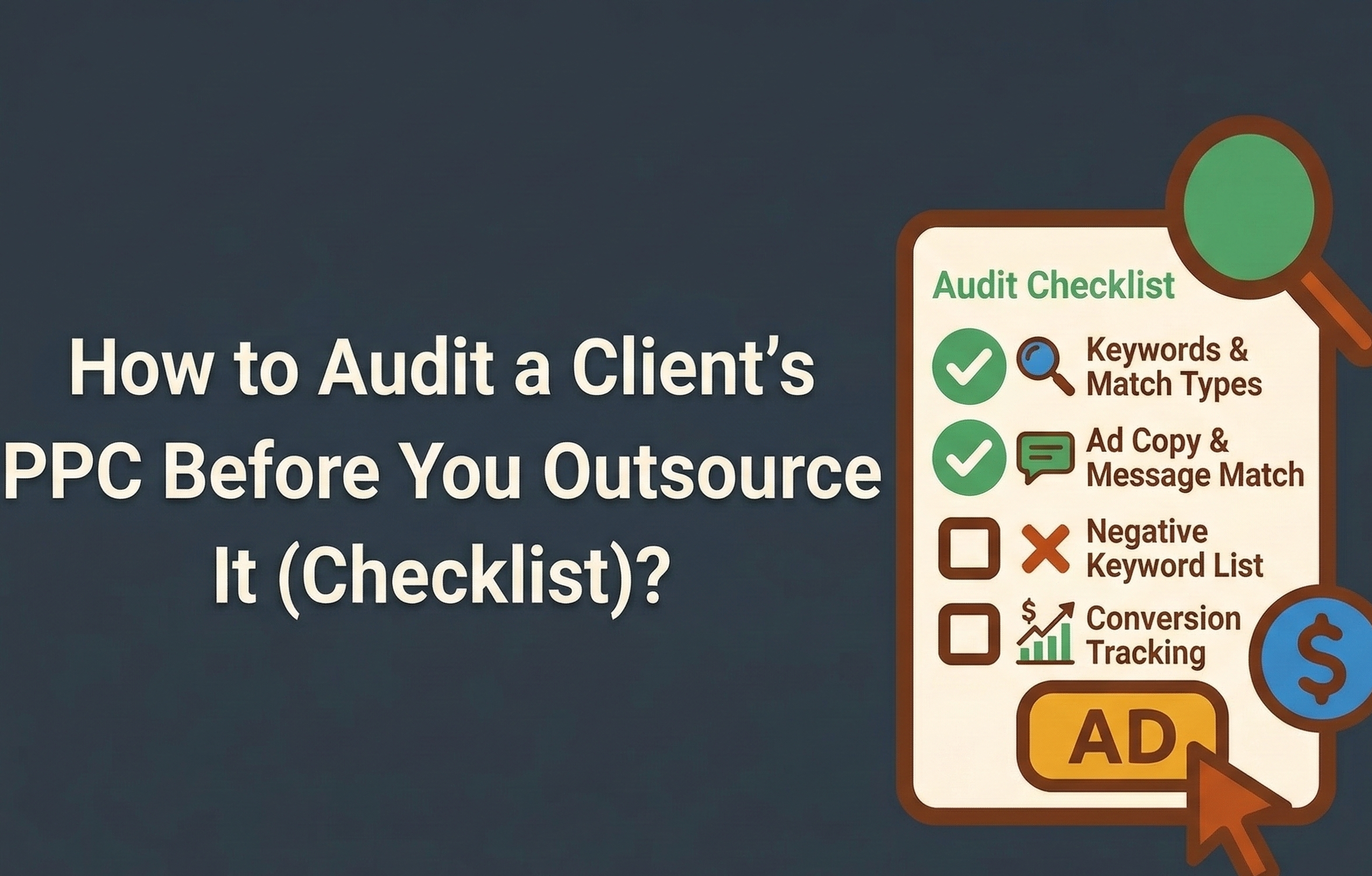
An agency owner lands a new client with a struggling Google Ads account. Excited to finally outsource the PPC work, they hand it off to a white-label partner, only to get on a call three weeks later with the client asking why results haven’t improved. The outsourcing partner is doing good work, but nobody knew the account had broken conversion tracking, zero negative keywords, and three years of unchecked wasted ad spend baked into its structure.
This scenario plays out constantly in agencies. The solution isn’t better outsourcing, it’s better preparation before outsourcing.
A structured PPC audit before you hand off any account gives you a clear baseline, surfaces hidden problems, and makes your white-label partnership dramatically more effective from day one. This guide walks you through a practical, step-by-step checklist you can use before outsourcing any client’s PPC account, whether you manage five clients or fifty.
What Is a PPC Audit?
A PPC audit is a structured, comprehensive review of a paid advertising account examining its structure, settings, spend efficiency, targeting, creative performance, and tracking setup. Unlike a surface-level performance review (which looks at numbers), a deep audit examines why those numbers exist and what structural or strategic issues are driving them.
Think of it this way: a performance review tells you the car isn’t accelerating. A PPC audit lifts the hood to determine whether the problem lies with the engine, the fuel, or the driver.
For agencies, a pre-outsourcing audit serves a specific purpose: to establish a clear, documented account of where the account stands before any external partner touches it. This protects your agency, sets realistic expectations with your client, and gives your white-label PPC partner the context they need to deliver results faster.
Why You Should Audit PPC Before Outsourcing
Most agencies skip the audit because it feels like extra work before the “real” work begins. Here’s why that’s a costly mistake:
- Understand the true baseline – You can’t set performance expectations without knowing where the account actually stands. Many clients inherit underperforming accounts from previous agencies, and without an audit, those legacy problems become your problem.
- Identify wasted ad spend – Industry data consistently shows that a significant portion of PPC budgets is wasted on irrelevant clicks, poor keyword targeting, and misaligned bidding. An audit quantifies this before it becomes a client complaint.
- Set realistic expectations – Clients often expect immediate improvement after switching agencies. An audit lets you show them exactly what’s broken and what the recovery timeline looks like before any promises are made.
- Protect agency-client relationships – If results don’t improve quickly after outsourcing, having documented pre-existing issues shields your agency from blame and keeps the relationship intact.
- Improve onboarding efficiency – A white-label PPC partner who receives a clean audit report can onboard faster, prioritize fixes correctly, and start optimization from a position of knowledge rather than discovery.
PPC Audit Checklist for Agencies (Step-by-Step)
Work through each section in order. Use the scorecard table at the end of this section to rate the account’s health in each category.
■ SECTION 1: Account Structure Review
Account structure is the foundation of everything. Poorly organized accounts make optimization harder, reporting messier, and budget control almost impossible.
☐ Campaign naming conventions are consistent and descriptive (e.g., Brand | Search | UK | Q1-2025)
☐ Campaigns are logically segmented by network (Search campaigns separate from Display campaigns)
☐ Ad groups contain tightly themed keyword clusters (not broad catch-all groups)
☐ Each campaign has a clear, singular objective (lead gen, brand awareness, eCommerce, etc.)
☐ Conversion tracking is active and verified, not just installed, but firing correctly
☐ Shared budgets are not masking individual campaign performance
☐ Location targeting is applied at the campaign level, not only the ad group level
☐ Ad scheduling is configured and aligned with the client’s business hours or peak intent windows
■ SECTION 2: Budget & Spend Analysis
Budget misallocation is one of the most common issues in inherited PPC accounts. This section helps you quantify where money is being wasted and where it should be redirected.
☐ Daily budget is set appropriately relative to monthly targets
☐ Impression share data reviewed: low impression share due to the budget is a red flag
☐ Search Impression Share (IS) Lost to Budget noted and benchmarked
☐ Cost-per-conversion reviewed at campaign and ad group level
☐ Campaigns with zero conversions but significant spend are flagged
☐ Budget distribution across campaigns aligns with business priorities
☐ Search Terms report reviewed for irrelevant traffic consuming budget
☐ Display campaigns (if any) are assessed separately, often have inflated click volumes with poor conversion rates
Use this quick budget audit snapshot to record what you find:
Metric | Current Value | Benchmark | Status |
Cost Per Conversion | $__ | Industry avg. |
|
Impression Share | %__ | >60% target |
|
Budget Utilization | %__ | 85–100% |
|
Wasted Spend % | %__ | <10% |
|
ROAS | x__ | >3x target |
|
■ SECTION 3: Targeting & Audience Review
Targeting defines who sees the ads. Poor targeting is one of the fastest ways to drain budget without generating quality leads or conversions.
☐ Keyword match types are deliberate, not defaulting to broad match across the board
☐ Negative keyword lists exist and are actively maintained
☐ Negative keywords applied at both campaign and ad group level where appropriate
☐ Audience segments defined and applied (remarketing, in-market, customer match)
☐ Observation vs targeting audiences clearly understood and applied correctly
☐ Geo-targeting reviewed, not accidentally targeting irrelevant locations
☐ Device bid adjustments reviewed mobile bids aligned with conversion rate data
☐ Demographic exclusions applied if data supports it (e.g., excluding age groups that never convert)
■ SECTION 4: Ad Copy & Creative Analysis
Even perfectly targeted campaigns fail when the ad copy isn’t compelling or relevant. Review ad creative as a direct reflection of Quality Score and user experience.
☐ Responsive Search Ads (RSAs) are in use; single expanded text ads only is a legacy issue
☐ Each ad group has at least 2–3 active ads for testing
☐ Ad copy directly reflects the keyword theme of its ad group
☐ CTR benchmarked against industry averages (Google’s own benchmarks by vertical are a useful reference)
☐ Ad Strength rating reviewed for each RSA (Excellent or Good is the target)
☐ Headlines include primary keywords naturally
☐ Descriptions include a clear call-to-action
☐ Ad extensions (assets) are configured with sitelinks, callouts, and structured snippets at a minimum
☐ No ads disapproved or serving with a limited status due to policy issues
■ SECTION 5: Conversion Tracking & Attribution
Conversion tracking is non-negotiable. Without it, you’re flying blind and so is your white-label partner. This is frequently the most critical finding in any PPC audit.
☐ Conversion actions are set up and tracking the right events (not just page views)
☐ Primary conversion action is designated correctly in Google Ads
☐ GA4 integration is active, and audiences are importing into Google Ads
☐ Conversion window is appropriate for the sales cycle
☐ Attribution model is reviewed and understood (data-driven is recommended where volume allows)
☐ No duplicate conversion tracking (inflated numbers indicate double-counting)
☐ Enhanced conversions or call tracking configured if phone leads matter
☐ Lead quality has been verified; form fills are being counted, not just landing page visits
■ SECTION 6: Bidding Strategy & Optimization
Bidding strategy ties directly to account objectives. Using the wrong bidding approach or relying on automation without sufficient data consistently underperforms.
☐ Bidding strategy is aligned with the campaign objective (not just defaulting to Maximize Clicks)
☐ Smart bidding campaigns have sufficient conversion data to function correctly (typically 30+ conversions per month)
☐ Target CPA or Target ROAS values are realistic and set based on actual historical data
☐ Manual bid campaigns have bid adjustments applied for device, location, and audience
☐ Optimization Score reviewed in Google Ads, but recommendations were evaluated critically before applying
☐ Automated rules reviewed, none are conflicting with manual bid adjustments
☐ Bid modifiers for time-of-day and day-of-week applied if conversion data supports it
☐ Portfolio bid strategies reviewed if multiple campaigns are sharing bid management
PPC Audit Scorecard: Rate the Account Health
After completing the checklist above, score each category from 1 to 5, where 1 = Critical Issues and 5 = Performing Well. Add your notes on the key findings.
Category | Score (1–5) | What to Look For | Notes |
Account Structure |
| Campaign naming, organization, and network separation |
|
Budget Allocation |
| Cost-per-conversion, impression share, wasted spend |
|
Targeting & Audiences |
| Match types, negative keywords, and geo-targeting |
|
Ad Copy & Creative |
| CTR, RSA usage, A/B test presence |
|
Conversion Tracking |
| GA4 integration, attribution model, lead quality |
|
Bidding & Optimization |
| Bid strategy, ROAS targets, automated rules |
|
Request a Professional White-Label PPC Audit from Pravrdh
Common Red Flags Found During PPC Audits
These are the issues Pravrdh’s audit team encounters most often in accounts that have been managed without proper oversight or handed off without a structured review:
- No Conversion Tracking – No Conversion Tracking
The single most damaging issue in any PPC account. Without it, smart bidding cannot optimize, reporting is meaningless, and nobody can measure ROI.
- Broad Match Overuse – Broad Match Overuse
Broad match keywords can generate significant impressions and clicks from completely irrelevant searches, silently burning budget without delivering qualified leads.
- No Negative Keyword Lists – No Negative Keyword Lists
Even a basic negative keyword strategy can reduce wasted spend by 15–30%. Accounts with no negatives are almost always overpaying for irrelevant traffic.
- High CPA with Low Conversion Volume – High CPA with Low Conversion Volume
If the account has low monthly conversion volumes (under 30), smart bidding strategies are operating without sufficient data, producing inconsistent and often poor results.
- Budget Draining on Poor Performers – Budget Draining on Poor Performers
Often, 20–30% of total account spend goes to campaigns or ad groups that have never converted. These should be paused or restructured, not just reduced.
- No A/B Testing in Place – No A/B Testing in Place
Accounts with a single ad per ad group and no rotation strategy are leaving performance improvement on the table. Consistent testing is fundamental to sustained PPC growth.
Schedule a Call to Review Your Client’s PPC Performance
When to Fix Internally vs When to Outsource?
Not everything requires outsourcing, but knowing where to draw the line is critical for both agency efficiency and client results. Use this reference table to guide your decision:
Situation | Fix In-House | Outsource to White-Label | Priority |
Minor naming/structure issues | ✅ |
| Low |
Poor ROAS despite good spend |
| ✅ | High |
No in-house PPC expertise |
| ✅ | High |
Bandwidth or capacity constraints |
| ✅ | High |
Missing conversion tracking | ✅ (quick fix) |
| Urgent |
Low volume, simple account | ✅ |
| Medium |
Scaling to multiple clients |
| ✅ | High |
A useful rule of thumb: if the issue is structural and fixable within a few hours, handle it internally before the outsourcing handoff. If the issue is strategic, data-driven, or requires ongoing expertise to sustain, that’s where a professional white-label partner adds the most value.
How a Professional White-Label PPC Audit Improves Results?
A professional audit from an experienced white-label PPC agency goes significantly deeper than what most in-house teams have the time or tooling to execute. Here’s what a structured professional audit includes and why it accelerates results:
Deeper Technical Review
Professional audits examine account history, Quality Score trends, landing page alignment, tag implementation, and cross-platform attribution, not just the surface-level metrics visible in the main dashboard. Pravrdh’s audit process, for example, reviews the complete account structure against Google’s own quality and optimization frameworks.
Advanced Bid Strategy Evaluation
Choosing the right bidding strategy isn’t as simple as enabling Smart Bidding. A professional audit evaluates conversion volume thresholds, target CPA viability, portfolio bidding opportunities, and the risk of over-relying on automation with insufficient data.
Competitive Context
Your client’s account doesn’t exist in isolation. Auction Insights data, impression share trends, and keyword gap analysis reveal how competitors are behaving and where your client has a strategic opportunity to capture more market share at a lower cost.
Long-Term Scaling Strategy
The best PPC audits don’t just fix what’s broken; they map a path forward. A professional audit should conclude with a prioritized action plan: what to fix first, what to test next, and what to build for scale.
White-Labeled Reporting
Pravrdh delivers all audit findings and ongoing PPC reporting under your agency’s brand. Your clients see your name, your logo, and your expertise while our team handles the technical depth behind the scenes. This is what professional white-label PPC outsourcing looks like in practice.
Frequently Asked Questions (FAQs)
How do you audit a PPC account?
Start with account structure (campaign organization, naming, network separation), then review budget allocation and wasted spend, targeting (keywords, match types, negatives, audiences), ad copy performance, conversion tracking accuracy, and finally bidding strategy. Work systematically through each layer using a documented checklist like the one above.
What should be included in a PPC audit?
A complete PPC audit should cover account structure, budget efficiency, keyword and audience targeting, ad copy and creative performance, conversion tracking and GA4 integration, and bidding strategy. Each area should be scored for health, with specific issues documented and prioritized for remediation.
How often should PPC accounts be audited?
At a minimum, a full PPC audit should be conducted quarterly for active accounts. High-spend accounts (above $10,000/month) benefit from monthly reviews. A comprehensive audit is also always recommended before any agency transition, outsourcing handoff, or significant budget change.
Why audit before outsourcing PPC?
Auditing before outsourcing establishes a documented performance baseline, identifies structural issues that could limit your partner's effectiveness, sets realistic expectations with your client, and ensures the white-label team starts from a position of full account knowledge rather than discovery, which significantly reduces time-to-results.
Is a PPC audit necessary before hiring an agency?
Yes, and it protects both the agency and the client. Without a pre-outsourcing audit, any underperformance after the handoff is difficult to diagnose, attribute, or correct. An audit creates accountability on all sides and gives the new partner the context they need to succeed from day one.
How to reduce wasted ad spend?
Start with a thorough review of the Search Terms report to identify irrelevant queries, then build and maintain negative keyword lists. Pause campaigns and ad groups with zero conversions and significant spend. Review match type strategy to reduce broad match exposure. Ensure smart bidding has sufficient conversion data before enabling it. These steps alone can reclaim 15–40% of the monthly budget in underperforming accounts.
Conclusion
A PPC audit before outsourcing is not optional; it’s what separates agencies that scale confidently from agencies that constantly fight fires after the fact.
The checklist in this guide gives you a structured, repeatable process for evaluating any client’s PPC account before it changes hands. When you know exactly what’s working, what’s broken, and what the realistic improvement trajectory looks like, you can set better expectations, brief your white-label partner more effectively, and deliver stronger client outcomes.
Auditing protects your margins, strengthens client trust, and turns outsourcing from a risk into a strategic advantage. It’s the difference between handing off a problem and handing off an opportunity.
Pravrdh specializes in white-label PPC management for scaling digital marketing agencies. Our team brings over 15 years of paid media expertise, 1,450+ successful projects, and a transparent, performance-driven approach to every account we manage, all under your agency’s brand.