
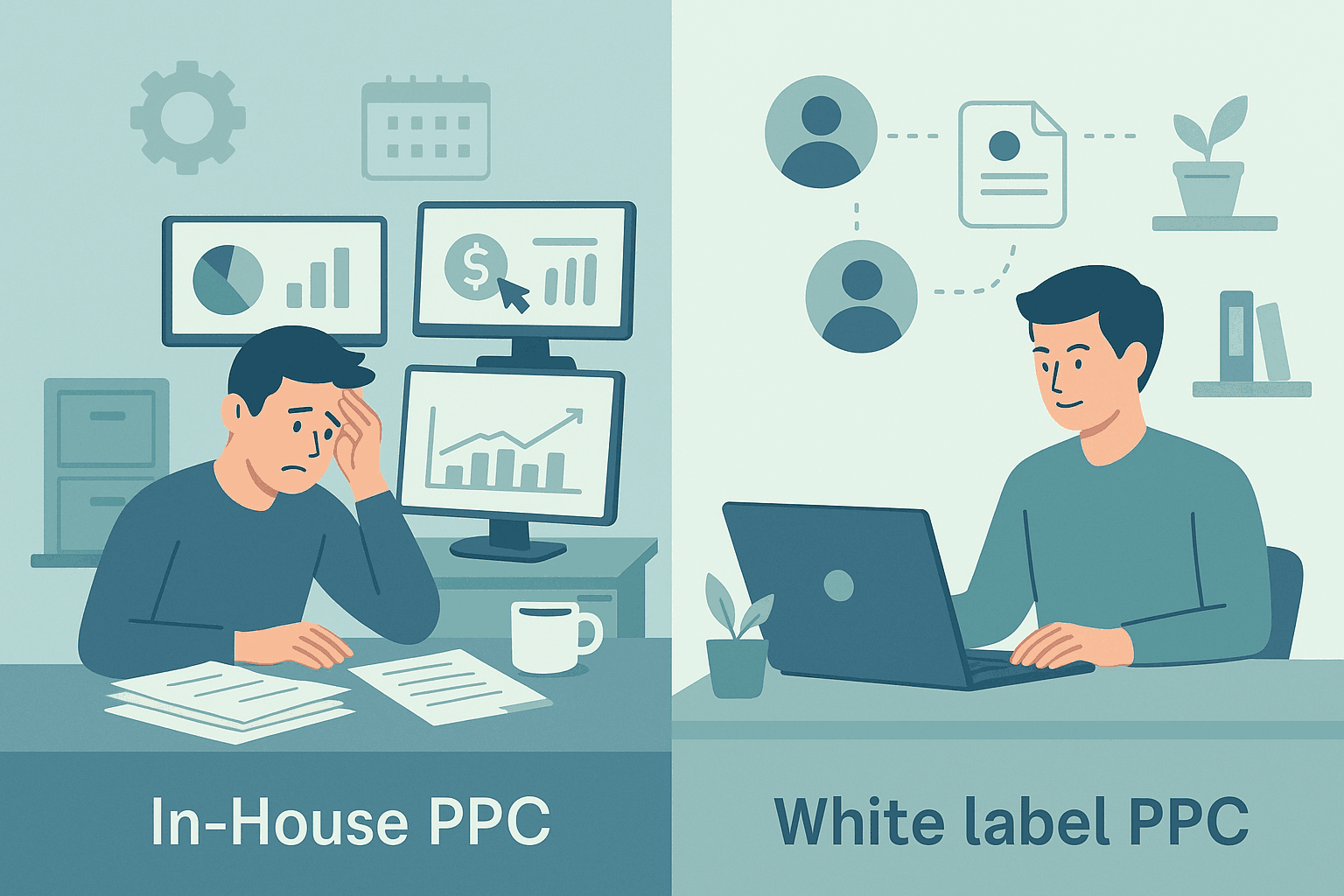
Agencies usually choose white-label PPC when they want to offer paid ads without adding payroll, hiring delays, tool sprawl, and delivery risk. In-house PPC can make sense at larger scale, but for many agencies, the hidden costs are higher than they look on paper. The smarter choice depends on your client volume, margin targets, and how much operational complexity your team can realistically absorb.
If you run a full-service, SEO, social media, or creative agency, this decision affects more than fulfillment. It changes your profit margin, your speed to launch, your client retention risk, and your ability to grow without burning out your team.
This guide breaks down the real cost of both models, where agencies usually underestimate expenses, and how to decide which setup fits your stage of growth.
What is in-house PPC?
In-house PPC means your agency hires and manages its own paid media team. That team may include a PPC manager, media buyer, copywriter, designer, analyst, or account strategist. Your agency owns the process, the tools, the deadlines, and the performance outcomes.
On paper, in-house PPC gives you:
- Direct control over campaign work
- Faster internal communication
- More influence over strategy and client experience
- A team that is fully immersed in your agency’s workflows
But it also means your agency takes on the full cost of recruiting, onboarding, training, managing, retaining, and replacing PPC talent.
What is white-label PPC?
White-label PPC means your agency partners with a specialist team to manage paid campaigns under your brand. Your agency still owns the client relationship. The white label partner handles the technical execution, reporting support, optimization, and platform expertise behind the scenes.
A good white label setup usually gives you:
- Faster service launch without hiring
- Access to specialists across Google Ads, Microsoft Ads, Meta Ads, and landing page strategy
- Predictable delivery costs
- White-labeled reporting and smoother account scalability
For agencies looking to grow without building a large internal paid media department, white-label PPC often reduces both financial risk and operational overhead.
What is the real difference between in-house PPC and white-label PPC?
The real difference is not just control. It is the cost structure.
In-house PPC turns paid media into a fixed-cost function. You carry salaries, benefits, software, training, and management overhead whether accounts are full, slow, or in transition.
White-label PPC makes paid media a more variable cost. You pay for fulfillment as client demand grows, which usually protects cash flow and makes margin planning easier.
That distinction matters because agencies rarely lose money on PPC because of ad spend alone. They lose money because the delivery model becomes too expensive, too slow, or too hard to scale.
Why do agencies underestimate the cost of in-house PPC?
Many agencies compare one line item against another:
- Employee salary
vs. - White label monthly fee
That comparison is incomplete.
The true in-house cost includes hiring, payroll burden, management time, onboarding drag, tool subscriptions, training, vacation coverage, performance inconsistency, and the risk of turnover. Even before benefits and software, hiring senior marketing talent is expensive. The U.S. Bureau of Labor Statistics reports median annual wages of $126,960 for advertising and promotions managers and $161,030 for marketing managers in May 2024. SHRM has also reported that the average cost per hire was nearly $4,700, and says both cost-per-hire and time-to-hire have increased in recent years.
For agencies, that means one “simple” PPC hire can become a meaningful fixed commitment long before the role reaches full productivity.
What are the hidden costs of in-house PPC?
1. Salary is only the starting point
A PPC specialist’s salary is not the same as the actual cost to the agency.
You still need to account for:
- Payroll taxes
- Benefits
- Paid time off
- Sick leave
- Bonuses or incentives
- Equipment and software
- Manager oversight
- Downtime between accounts
That is why the real cost of an in-house PPC hire is often much higher than the monthly paycheck.
2. Hiring delays slow revenue
Agencies often decide to hire when they win a few PPC opportunities. The problem is timing.
You may close the client this month, but your new hire may not be sourced, interviewed, onboarded, trained, and fully productive for several weeks or longer. During that window, your options are limited:
- Delay launch and frustrate the client
- Rush internal staff into unfamiliar PPC work
- Depend on freelancers with inconsistent availability
- Founders step in and create bottlenecks
That delay creates hidden revenue leakage.
3. Onboarding costs are real, even when ignored
New PPC hires need time to learn:
- Your client portfolio
- Your QA process
- Your reporting style
- Your communication standards
- Your strategy frameworks
- Your preferred tools
In most agencies, the first 30 to 90 days are not a time of peak productivity. Senior staff spend hours reviewing work, correcting issues, and training the new person. Those hours are real costs, even if they never appear in a finance sheet.
4. Tool sprawl increases fast
An in-house PPC function often needs more than the ad platforms themselves.
Common tool categories include:
- Keyword and competitor research
- Reporting and dashboard software
- Landing page testing tools
- Call tracking
- Heatmaps and CRO tools
- Project management and QA tools
One employee can use several systems. A growing team multiplies those costs quickly.
5. Training never stops
Paid media platforms change constantly. Campaign types, automation, attribution models, privacy shifts, creative formats, audience signals, and reporting views all evolve.
That means ongoing investment in:
- Certifications
- Platform education
- New feature testing
- SOP updates
- Internal QA reviews
This is not optional if you want consistent performance. Google’s own guidance emphasizes that helpful content and strong search visibility come from original, useful, people-first work rather than thin, recycled, or ranking-first production. The same principle applies to PPC service content and thought leadership: shallow execution and shallow explanation both age poorly.
6. One person rarely covers the full PPC stack
Let’s break it down with a real-world scenario.
You charge a client $2,000 per month for PPC management.
- If you use white label PPC at $700 per month, you earn $1,300 profit.
- If you manage it in house and your total cost per client is $1,600, your profit drops to $400 and that’s before taxes.
White label PPC gives you better margins without the added complexity of managing a full team.
7. Turnover creates delivery risk
When a PPC employee leaves, agencies lose more than a team member. They lose platform knowledge, account context, workflow continuity, and client confidence.
Then the cycle starts again:
- Backfill the role
- Reassign work
- Review account health
- Retrain a replacement
- Calm worried clients
That instability is one of the highest hidden costs in the in-house model.
8. Founder and leadership time gets absorbed
Many agency owners say they want control. What they often get is supervision.
That means more time spent on:
- Hiring interviews
- Performance reviews
- Escalations
- Strategy approval
- Client rescue calls
- Cross-team coordination
Every hour spent managing PPC operations is an hour not spent on sales, partnerships, positioning, or retention.
What does white-label PPC usually cost?
White-label PPC pricing usually follows one of three models:
| Pricing model | How it works | Best for |
| Flat monthly fee | Fixed fee per account or service tier | Agencies that want predictable margins |
| Percentage of ad spend | Fee scales with client spend | Agencies with larger and variable budgets |
| Hybrid model | Base fee plus scope-based add-ons | Agencies with mixed account complexity |
Most agencies prefer white-label delivery because it consolidates a broad set of hidden internal costs into a single, clearer fulfillment cost. That makes margin forecasting easier and protects cash flow during growth periods.
How do the costs compare side by side?
Here is a simple comparison most agencies can use.
| Cost category | In-house PPC | White label PPC |
| Salary and payroll burden | High fixed cost | None |
| Recruiting and hiring | Ongoing | None |
| Onboarding and ramp-up | High | Minimal |
| Tool subscriptions | Usually separate | Often bundled or reduced |
| Training and certifications | Ongoing | Usually handled by a partner |
| Vacation and sick coverage | Your responsibility | Covered by the partner team |
| Account scalability | Limited by headcount | Easier to expand |
| Management oversight | High | Lower |
| Margin predictability | Lower in early growth | Usually higher |
| Time to launch the service | Slower | Faster |
This table does not mean white label is always cheaper in every situation. It means it usually reduces fixed overhead and complexity, especially for agencies with inconsistent PPC demand or fewer than 15 to 20 active PPC accounts.
Which model is more profitable for agencies?
For many small and mid-sized agencies, white-label PPC is more profitable because it preserves margin without forcing early payroll expansion.
Example: one client, same monthly retainer
Let’s say your agency charges $2,500 per month for PPC management.
In-house model
A realistic share of labor, tools, oversight, and admin might push your internal delivery cost to $1,600 to $2,000 per month per client, depending on utilization.
White label model
If your fulfillment cost is $700 to $1,100 per month, your remaining gross margin is easier to protect.
Scenario | Revenue | Delivery cost | Gross margin |
In-house PPC | $2,500 | $1,800 | $700 |
White label PPC | $2,500 | $900 | $1,600 |
That difference matters when you multiply it across several accounts.
Now imagine five clients:
Model | Revenue from 5 clients | Estimated delivery cost | Estimated gross margin |
In-house PPC | $12,500 | $9,000 | $3,500 |
White label PPC | $12,500 | $4,500 | $8,000 |
The point is not that every white label engagement costs the same. The point is that agencies often underestimate how much margin gets lost when in-house capacity is underutilized or overmanaged.
When does in-house PPC make sense?
In-house PPC can be the right choice when your agency has enough volume, process maturity, and leadership bandwidth to support a dedicated team.
It usually makes more sense when:
- You have a steady pipeline of PPC work year-round
- You manage a large number of active PPC accounts
- You need highly customized enterprise workflows
- You already have strong internal leadership for paid media
- You want long-term operational ownership over every part of delivery
- Your margins can absorb slower hiring cycles and overhead
In other words, in-house PPC becomes more attractive when your agency is already operating at a scale that can keep specialists fully utilized.
When is white label PPC the smarter option?
White-label PPC is usually the smarter option when your agency wants to grow PPC revenue without first building a full delivery department.
It tends to be a strong fit when:
- You are launching PPC as a new service
- Your current team is overloaded
- You want to add PPC without delaying the client launch
- You sell SEO, social, design, or branding, and need expert paid media support
- You want better margins without immediate hiring
- You want specialist execution without an internal training burden
For many agencies, this is the lowest-risk way to expand service offerings while maintaining quality.
What questions should you ask before choosing?
Before deciding, ask these seven questions:
1. How many PPC clients do we have now?
Do not base your team structure on hopeful future volume alone.
2. How fast do we need to launch?
If speed matters, hiring may slow you down.
3. Can we keep a PPC specialist fully utilized?
A partially utilized hire can crush margin.
4. Do we have senior PPC oversight internally?
Without this, quality control becomes difficult.
5. Can we absorb turnover without client disruption?
If not, your risk is higher than it seems.
6. Are we trying to protect cash flow?
White-label models usually reduce exposure to fixed costs.
7. Do our clients need deep paid media expertise right now?
If yes, buying expertise may be smarter than building it slowly.
What are the biggest mistakes agencies make with this decision?
Hiring too early
Agencies add payroll before they have a stable account volume.
Choosing based on ego, not economics
“Control” sounds attractive, but it does not always improve profit or results.
Underpricing PPC retainers
Agencies sell PPC without fully pricing delivery complexity.
Ignoring management cost
Leadership time is a real operational expense.
Using freelancers as a long-term substitute for systems
Freelancers can help, but many agencies outgrow ad hoc delivery fast.
How can you reduce risk, no matter which model you choose?
No matter which route you choose, do these things:
- Define your minimum margin per PPC account
- Standardize onboarding and reporting
- Audit account quality monthly
- Set clear campaign ownership rules
- Build SOPs for communication and approvals
- Track fulfillment time by account, not just revenue
These habits help agencies avoid hidden margin loss in either model.
FAQs
Is white-label PPC cheaper than hiring in-house?
Usually, yes for small and mid-sized agencies. White-label PPC often reduces fixed overhead by avoiding recruiting, payroll burden, training, and tool sprawl. It becomes especially cost-effective when your PPC client volume is still growing.
Is in-house PPC better for quality?
Not automatically. Quality depends on process, expertise, review standards, and account ownership. A strong white-label partner can outperform a thin in-house setup if the partner has better systems and deeper paid media specialization.
Will clients know if we use a white-label PPC partner?
In most white label arrangements, no. The partner works behind the scenes while your agency manages the client relationship, branding, and communication.
How many PPC clients justify an in-house team?
There is no universal number, but in-house is usually more practical when you have sufficient stable volume to keep paid media specialists fully utilized and supervised without hurting margins.
Does white-label PPC reduce control?
It changes control more than it removes it. Your agency still controls positioning, client communication, goals, and approvals. The partner usually handles implementation, optimization, and reporting support.
Which option is better for agency growth?
For many growth-stage agencies, white-label PPC is the faster, lower-risk option because it lets you add delivery capacity without waiting on hiring, training, or internal team expansion.
Conclusion
In-house PPC is not wrong. It is simply more expensive, slower to build, and harder to scale than many agencies expect. White-label PPC is not just an outsourcing choice. It is often a margin, speed, and risk-management decision.
If your agency already has strong paid media leadership and enough stable demand to support a dedicated team, in-house PPC may be the right long-term model. But if you want to launch faster, protect profit, reduce overhead, and scale with less operational strain, white-label PPC is often the more practical path.
A measured approach works best: choose the model that matches your current stage, your real client volume, and your team’s ability to deliver consistently. For agencies seeking expert execution without adding unnecessary overhead, Pravrdh can be a useful behind-the-scenes partner as you scale PPC with greater confidence and less operational overhead.